Strategy
Rethinking the Consumer Journey: Leveraging Neuromarketing Principles to Alter Consumer Perception

Imagine walking into a supermarket or department store. From the get-go, you’re greeted by an assortment of products made from different ingredients or materials. How do you go about choosing products that best meet your needs? What about choosing items that align with your values and expectations?
The answer lies in contextual framing. Research suggests that the way how products are presented plays a significant role in shaping consumer decisions. In essence, it’s not just about what the product offers—the product’s narrative and whether it resonates with consumers is just as important.
Contextual influences shape consumer perception
Today’s consumers are focusing more on environmental sustainability. A 2023 KPMG survey found that 36% of consumers consider sustainability as an important factor in their purchasing decisions.
However, just because a product is labeled as “sustainable” doesn’t automatically mean that consumers will perceive it positively.
A recent study by de Wijk et al. (2024) explored how consumer perceptions of sustainable food products and clothing fabrics influence consumers’ purchasing decisions and consumption experiences. Contextual framing plays a key role in how consumers perceive a product. These include how a product is labeled, how and where it’s presented, and its composition. For instance, t-shirts made from novel materials like nettles and polylactic acid (PLA) elicited positive reactions compared to reused or second-hand shirts.
Moreover, despite the sustainability of the latter, it is still viewed less favorably compared to recycled t-shirt samples. Both are pre-worn and thoroughly cleaned. However, recycled clothing goes through an extra step: remanufacturing. This turns scrap material into fibers that are then used to make new clothes. Meanwhile, reused clothing is often sold as is.
Despite being sustainable options, the study’s results underscore the need for brands to properly frame their products, including the ingredients and materials used. This is a crucial step to overcoming consumers’ preconceived notions or biases.
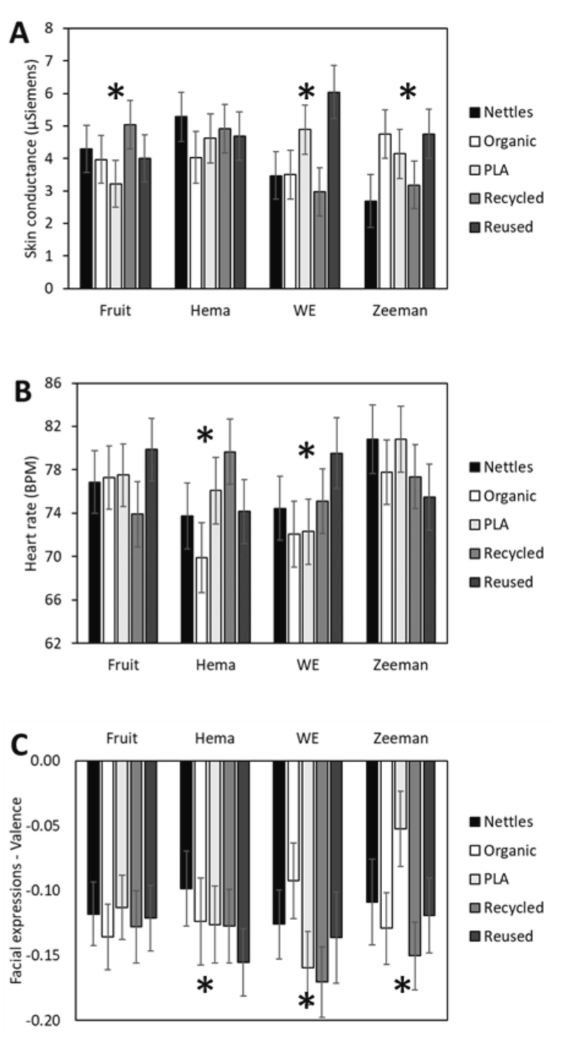
The graphs above show the effects of ingredient specification on skin conductance, heart rate, and facial expressions when the study’s participants were asked to feel different types of t-shirt fabrics. These indicate that participants were able to distinguish the shirts’ tactile properties, as evidenced by their skin conductance and heart rate measurements. These also show the differences between emotions triggered by the customers’ preceding journeys from discount stores vs. upscale stores.
For instance, when asked to feel fabric t-shirts made from organic cotton and sold in an upscale store, participants had a relatively lower heart rate and skin conductance, indicating that the shirts meet the customers’ expectations.
When it came to fabric material, such as nettle, which is usually associated with stinging and prickling sensations, the study recorded no negative skin conductance or facial expressions. These findings potentially indicate that the material information provided during the customer’s journey helped mitigate any negative perceptions that the participants may have had about shirts made from nettles.
A new case for sustainability and the development of sustainable products
Consumers’ emotions play a critical role in their decision-making processes. The study showed that, despite having sustainability claims, some of the products still faced initial skepticism. This indicates that information about the type of store, ingredients, or materials can affect how consumers respond to a particular product.
It’s no longer enough for brands to label their offerings as “sustainable” or “eco-friendly.” For brands to develop and promote sustainable alternatives that will be successful in the market, they must be transparent about their product’s benefits.
The study also found that consumers are more open to innovative materials like polylactic acid fabrics. This positive reception could be attributed to the information about the material provided during their customer journey, which alleviated the initial negative feelings that the study’s participants might have had toward such new or innovative materials.
You must therefore tailor your sustainability messaging. The success of your sustainable offerings will depend on how relatable their narratives are. Providing your customers with detailed explanations about a product’s origins and the benefits of sustainable ingredients can help build consumer trust and drive further engagement.
Practical insights on the new consumer journey to redefine your marketing strategy
While today’s consumers are increasingly leaning toward sustainability initiatives and are willing to spend nearly 10% more on sustainably produced goods, it’s not enough for brands to label their offerings as sustainable or make sustainability claims. You need to communicate these attributes to your target audience.
That begins with your product strategy and marketing and extends to your labels and packaging. This is crucial because according to the same KPMG survey, 51% of consumers check the product label for indicators like green certifications, ingredients, or material content. Moreover, 45% make their decision based on product descriptions or marketing.
How can you apply these principles to fine-tune your marketing strategy?
- Extend context to your storefront: Contextual framing also covers the product environment. This means positioning your products in environments that align with their narratives. IKEA’s “Sustainable Living Shop” exemplifies this by positioning their eco-friendly products in a dedicated space, reinforcing the brand’s commitment to affordable, sustainable living. Additionally, placing sustainable products in upscale settings may enhance their perceived value, as well as correspond with consumers’ expectations.
- Create clear messaging: Simplify your sustainability claims so they’re easily relatable and more credible. Avoid overwhelming your customers with too many technical details or jargon.
- Leverage emotional insights: Monitor emotional reactions to how your product is framed. For example, if you receive positive reactions to a certain product, you can reinforce this association through transparent communication and storytelling. According to NIQ poll data, 56% of consumers like knowing about a brand’s story. Through storytelling, you’re able to highlight your values and mission, which can help your brand make a positive impression on consumers.
Creating better consumer journeys
What are the best circumstances for applying the abovementioned principles?
- When you want to meet consumer expectations: When your product’s narrative aligns with consumer expectations, applying neuromarketing principles like contextual framing can help drive consumer engagement and trust, especially for brands looking to position themselves as innovative or eco-friendly.
- When you want to test new product concepts: Before launching new products, conduct small-scale tests first, especially if you’re working with sustainable or innovative materials. For example, if you’re manufacturing eco-friendly fabrics using alternative materials, highlight their uniqueness and how they fit into your brand’s sustainability narrative.
- When you want to minimize cognitive dissonance: Using emotional cues and positive framing can help you deliver clear and relatable messaging about your product. This, in turn, can mitigate skepticism and cognitive dissonance during pre-purchase and post-purchase stages.
Changing consumer perception one customer journey at a time
The consumer journey encompasses a series of impactful interactions that shape customer perceptions and decisions.
The study by de Wijk et al. (2024) underscores the importance of transparent and relatable sustainability narratives. Consumers are more likely to embrace sustainable products when they come with clear and compelling information that aligns with their expectations. For instance, when it comes to sustainable or innovative products, framing them strategically allows you to build trust and appeal.
By applying neuromarketing principles, you can create campaigns that resonate with your audience on a deeper level to drive engagement and measurable success.
Key takeaways:
- Framing matters: Providing consumers with clear and positive communication about your sustainability practices can help mitigate negative perceptions and enhance consumer acceptance.
- Craft tailored strategies: When marketing products as sustainable, make sure to focus on their context, which can affect consumers’ perception of such goods. For example, for sustainable food products, it’s important to go beyond focusing on the taste. This means paying attention to the information placed on the packaging and label, as well as accounting for your customers’ prior interactions with your products.
- Use multisensory cues: Aside from leveraging visual cues, incorporating tactile and contextual storytelling can help enhance consumer trust and acceptance of novel products.
- Combat negative bias: Even though consumers know that certain foods or products are better for them or the environment, irrational reactions, such as disgust over reused clothing vs. recycled clothing, and unconscious biases may prevent them from adopting such alternatives. Educating your customers and emphasizing the quality of sustainable alternatives compared to traditional products can help address these biases.


